
Hungarian university orals (szóbeli, kollokvium) reward a clear tétel outline and the ability to speak without reading. Most AI study content ignores that format. Generic night-before guides and lifestyle blogs own the search results; they rarely start from your lecture PDF.
This post starts on paper. ScienceIQ speeds the practice step. It does not sit the oral for you.
What a usable tétel outline contains
For each topic on the list, write one page with four blocks:
| Block | What to put | Timebox |
|---|---|---|
| Title | Exact wording from the topic list | 1 min |
| Anchor | One sentence: what this topic is for | 2 min |
| Skeleton | 5–7 keywords / subheads in order | 8 min |
| Landmines | Definitions, exceptions, numbers you always forget | 4 min |
Do not write a full essay. Orals punish scripts you cannot hold in working memory.
Worked example (paraphrased lecture page)
Suppose your public-law PDF covers “judicial review of administrative acts” (names shortened on purpose):
Courts review legality, not expediency. Standing requires a personal interest. Extraordinary remedies are exceptional. Deadlines are strict.
Closed-book outline you can actually say aloud:
- 1. Title: Judicial review of administrative acts
- 2. Anchor: Review checks legality of administrative action, not whether the decision was wise.
- 3. Skeleton: legality vs expediency → standing → remedies → deadlines → one classroom example
- 4. Landmines: “personal interest”; which remedy is extraordinary; what happens if the deadline is missed
Cover the PDF. Speak for three minutes. Mark where you stalled. Those stalls become flashcard fronts or quiz items.
A 40-minute block per tétel
- 1. Open only the slides for that topic (5 min skim).
- 2. Close the file. Write the four-block outline from memory (10 min).
- 3. Check against the PDF. Fix the skeleton, not the prose (10 min).
- 4. Speak the outline once, timed (5–8 min).
- 5. Turn misses into 5–8 prompts (7 min).
Repeat the next day with notes closed first.
Where ScienceIQ fits (and how we differ)
As of October 2026, Hungarian oral formats get little coverage in AI study blogs. Tip lists talk structure without tying practice to this term’s PDF. Astra’s Hungarian night-before guide (public post, still live as of October 2026) helps last-minute triage; it is not a tétel-outline system.
ScienceIQ helps when the bottleneck is turning your uploaded lecture into retrieval:
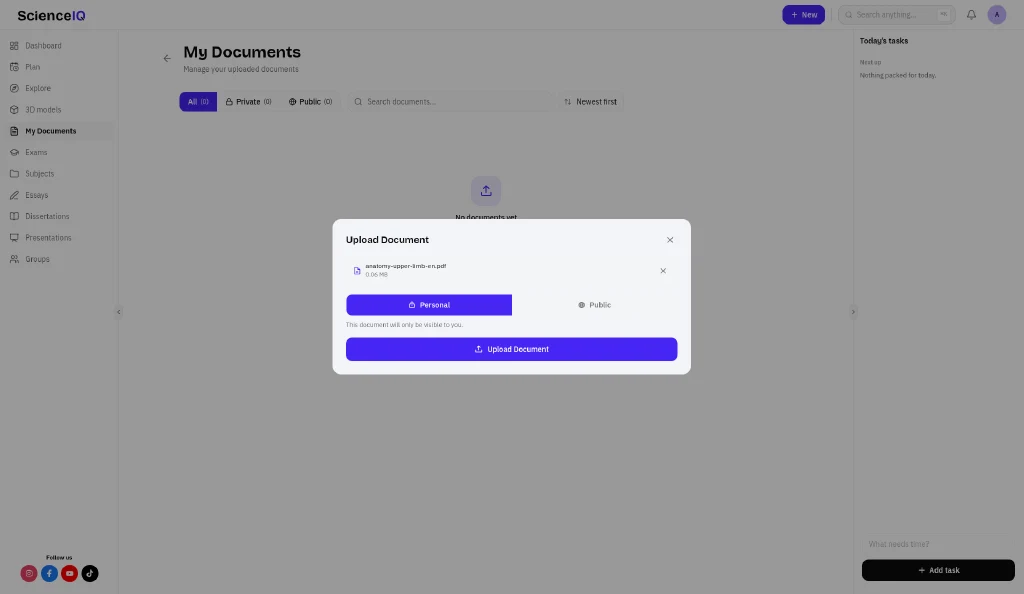
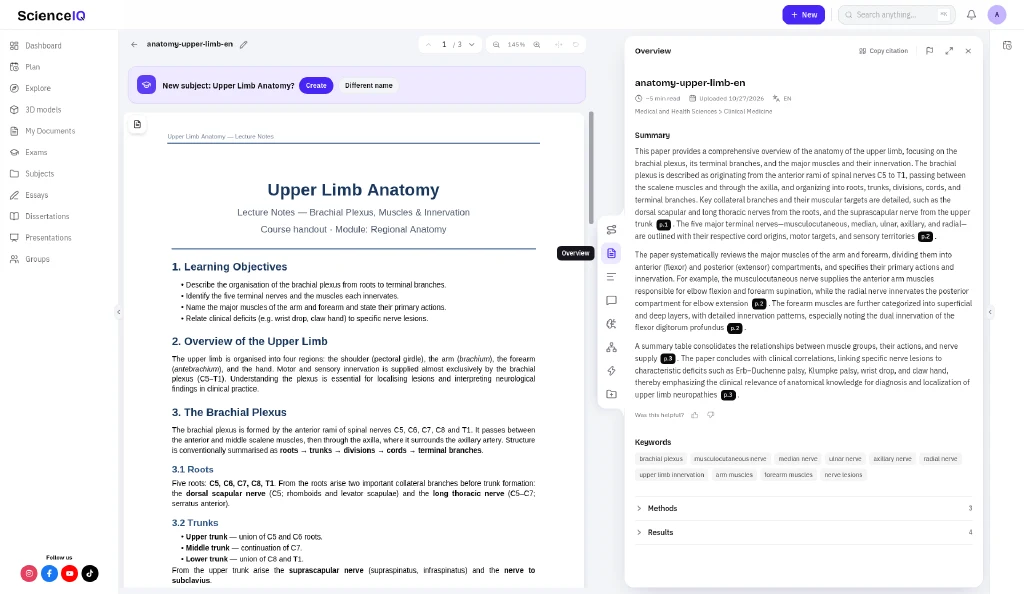
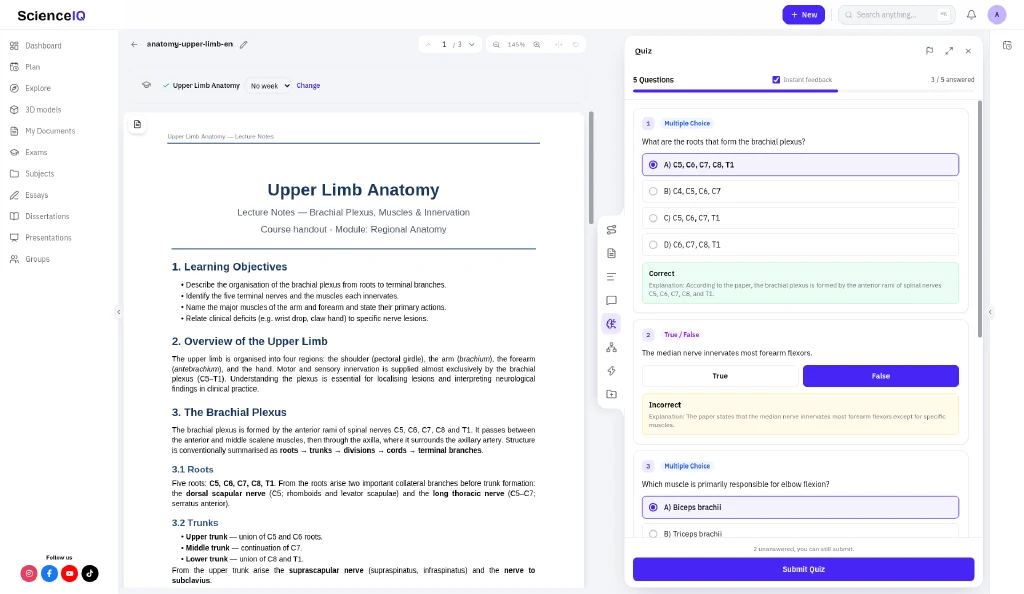
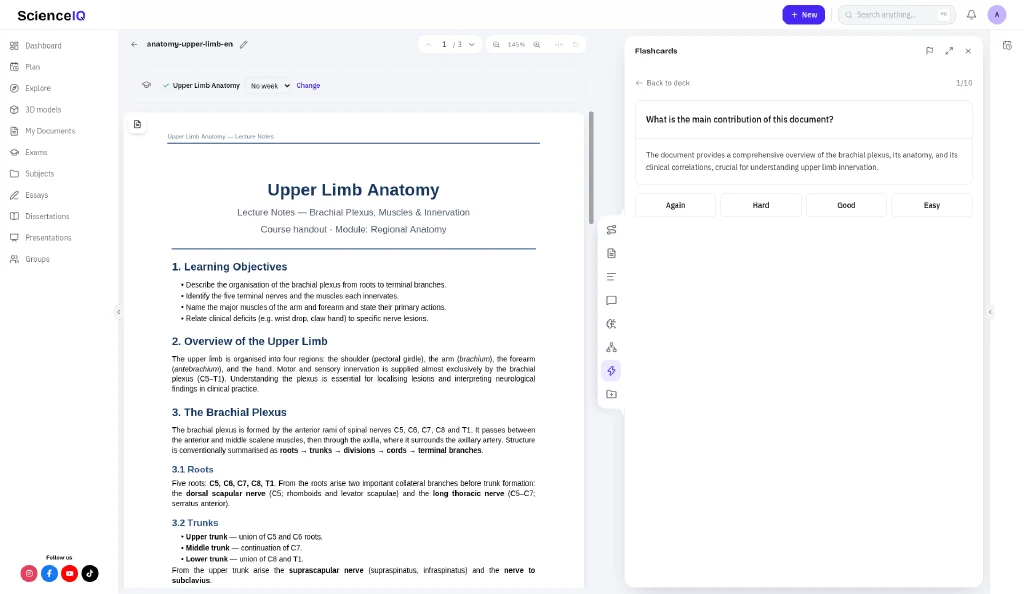

- Upload the PDF / PPTX your course posted.
- Use Overview to orient, then Quiz and Flashcards (spaced) for closed-book practice.
- Use Chat to check a single point against the uploaded lecture, not the open web.
- Optionally create a dated Exam and attach those materials so the oral date sits next to the files.
- Hungarian UI is available if that is how you study.
Practice here is closed-book retrieval on your files. The oral itself is still yours to speak.
Try it on the next topic on your list
Pick one tétel. Write the four-block outline by hand today. If you want help generating the first quiz pass from the lecture file, upload that PDF and keep only the items that match your topic list.
Essayer
Transformez vos notes de cours, diapositives et documents en résumés, quiz et flashcards générés à partir de votre matière, et mettez la science au service de vos révisions. Essayer ScienceIQ.
Références
- Dunlosky, J., Rawson, K. A., Marsh, E. J., Nathan, M. J., & Willingham, D. T. (2013). Improving Students’ Learning With Effective Learning Techniques: Promising Directions From Cognitive and Educational Psychology. Psychological Science in the Public Interest, 14(1), 4–58.
- Roediger, H. L., & Karpicke, J. D. (2006). Test-Enhanced Learning: Taking Memory Tests Improves Long-Term Retention. Psychological Science, 17(3), 249–255.
Erik Fazakas
Founder of ScienceIQ
Blog
Plus d'articles
 Lire la suite
Blog
Med-school anatomy quizzes from your own notes PDF
Anatomy volume is brutal, and generic banks drift from your course PDF. A closed-book quiz loop on the exact lists and diagrams you were given — plus a mind map of systems.
EErik Fazakas • 27 oct. 2026 Lire la suite
Blog
Create a dated exam and attach the PDFs you will be tested on
Study plans stay abstract until the exam date and the exact files live in one place. A concrete setup: one exam object, attached PDFs, then quiz and cards on those files only.
EErik Fazakas • 27 oct. 2026- Lire la suite
Blog
Economics exam prep: concept cards from lecture slides
Fuzzy definitions fail econ exams. Build concept and model cards from the slides your professor actually uses — then quiz the pairs you keep mixing up.
EErik Fazakas • 27 oct. 2026